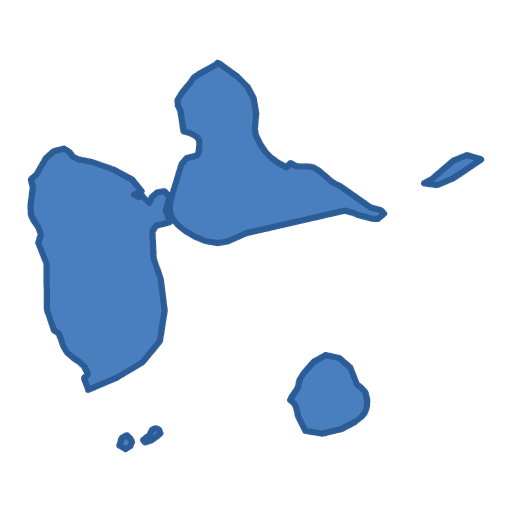
Guadeloupe Region
Guadeloupe is a butterfly-shaped archipelago in the Lesser Antilles and, since 1946, an overseas department of France. It is also a region of France and an outermost region of the European Union, and it uses the euro. The Guadeloupe Islands tourist board describes its culture as a blend of Amerindian, African, European and Indian influences, and well-known expressions of it include gwoka drumming, zouk music, colombo curries and ti’ punch.
Top local food in Guadeloupe
Top local drinks in Guadeloupe
Ti punch • rum • fruit juices
Top local desserts in Guadeloupe
Key facts
- Status
- Overseas department and region of France, and an outermost region of the European Union
- Capital
- Basse-Terre
- Area
- 1,628 km²
- Population
- 383,569 (INSEE, 2022)
- Languages
- French and Guadeloupean Creole
- Currency
- Euro
- Highest point
- La Grande Soufrière, 1,467 m
- UNESCO heritage
- Gwoka, inscribed in 2014
A butterfly of islands
Wikipedia lists six inhabited islands, Basse-Terre, Grande-Terre, Marie-Galante, La Désirade and two of the Îles des Saintes, and gives a total area of 1,628 square kilometres, the figure used by IEDOM, the Banque de France’s overseas institute. Seen from the sky, the islands look like a butterfly, France.fr says, and the tourist board calls Basse-Terre and Grande-Terre the two wings. Basse-Terre, in the west, is volcanic; its volcano La Soufrière, 1,467 metres high according to the tourist board, is described by both the tourist board and Wikipedia as the highest peak in the Lesser Antilles. Grande-Terre, in the east, is flatter, with white-sand beaches. The capital is Basse-Terre, and Pointe-à-Pitre is the main centre of business.
INSEE counted 383,569 residents in 2022, fewer than the 404,635 of 2011. IEDOM lists French and Creole as the languages spoken.
From Karukera to an overseas department
The Guadeloupe Islands tourist board says that Arawaks, followed by Caribs, lived on the islands before the Europeans and named the island Karukera, “the island of beautiful waters”; IEDOM likewise says the Carib, or Kalina, people gave the island that name. Christopher Columbus landed in 1493, on his second voyage, and named it after the Spanish monastery of Santa María de Guadalupe, according to the tourist board, which adds that the French settled permanently in the 17th century, sugar cane followed, and thousands of Africans were deported to work the plantations.
IEDOM records that slavery was definitively abolished in 1848, at the instigation of the MP Victor Schœlcher, after a first attempt under the National Convention in 1794. The tourist board recalls Louis Delgrès, a Creole officer who in 1802 opposed Napoleon’s attempt to reinstate slavery and whose fight is commemorated at Fort Delgrès in Basse-Terre, and points to the Mémorial ACTe in Pointe-à-Pitre, a centre for the memory of slavery and the slave trade. IEDOM dates the island’s status as an overseas department to the law of 19 March 1946, and notes that in 2007 Saint-Martin and Saint-Barthélemy, once municipalities of Guadeloupe, became territories of their own.
Gwoka, zouk and Carnival
UNESCO added gwoka to its Representative List of the Intangible Cultural Heritage of Humanity in 2014. It combines responsorial singing in Guadeloupean Creole, rhythms played on the ka drums and dancing, and UNESCO says several thousand people regularly practise it at open-air gwoka evenings, where dancers and soloists enter a circle in turn and perform facing the drums. The tourist board and Wikipedia both place its origins in the 17th century, in the era of slavery, and say it rests on seven basic rhythms.
AFP describes the band Kassav’, founded in 1979, as the creator of the fast-beat zouk style that brought it global fame in the 1980s, with gwo ka as its base style. Carnival runs from January to Ash Wednesday, the tourist board says, with the grand Fat Sunday parade in Pointe-à-Pitre, the largest parade through Basse-Terre on Fat Tuesday, and the symbolic burial of Vaval, the carnival king, at the end.
Colombo, bokit and ti’ punch
The French guide Routard describes colombo as a curry, often made with chicken but also with pork, goat, lamb or fish, and credits the spice mix behind it, built on coriander, cumin, turmeric, fenugreek, chilli and ginger, to Indians who arrived in the second half of the 19th century; Wikipedia notes that some 41,000 indentured labourers came from India after 1854. The tourist board calls colombo a traditional Creole stew, and bokit, a fried bread filled with meat, fish or marinated vegetables, the archipelago’s must-have sandwich. Routard adds that almost every menu offers accras, fried salt-cod fritters, to start, and often boudin créole.
The tourist board calls ti’ punch the archipelago’s signature cocktail: rhum agricole, lime and a little cane sugar, served as an aperitif. Wikipedia describes a French Caribbean custom in which each drinker builds their own, and Routard says there is no single recipe and that in bars the bottle is often put on the table for everyone to help themselves.
In Emblem World, Guadeloupe has its own territory pavilion within France, where people discover and rate local food, drinks, desserts and music.
Sources
- IEDOM (Banque de France): Guadeloupe at a Glance, Express Note No. 275 (July 2014)
- INSEE: Growth and structure of the population in 2022, Region of Guadeloupe (01) (26 June 2025)
- UNESCO Intangible Cultural Heritage: Gwoka: music, song, dance and cultural practice representative of Guadeloupean identity
- Guadeloupe Islands tourist board: Guadeloupe History
- Guadeloupe Islands tourist board: Gwoka
- Guadeloupe Islands tourist board: Carnival in Guadeloupe
- Guadeloupe Islands tourist board: Local delicacies (Nelly Martinvalet, 26 June 2025)
- Guadeloupe Islands tourist board: Basse-Terre
- Guadeloupe Islands tourist board: Grande-Terre Island
- France.fr (Atout France): Visit the Guadeloupe Islands
- The Local France (AFP): Guadeloupean pioneer of Caribbean zouk music dies after Covid infection (31 July 2021)
- Routard: Quoi manger en Guadeloupe : spécialités, cuisine, restaurants
- Wikipedia: Guadeloupe
- Wikipedia: Gwo ka
- Wikipedia: Ti' punch
Checked by Emblem editorial on 18 October 2026.